If you’ve spoken to a marketing agency lately, you’ve probably heard three acronyms thrown around: SEO, AEO and GEO. Each one gets pitched as the thing your business can’t survive without. It’s no surprise most business owners aren’t sure what they’re actually paying for.
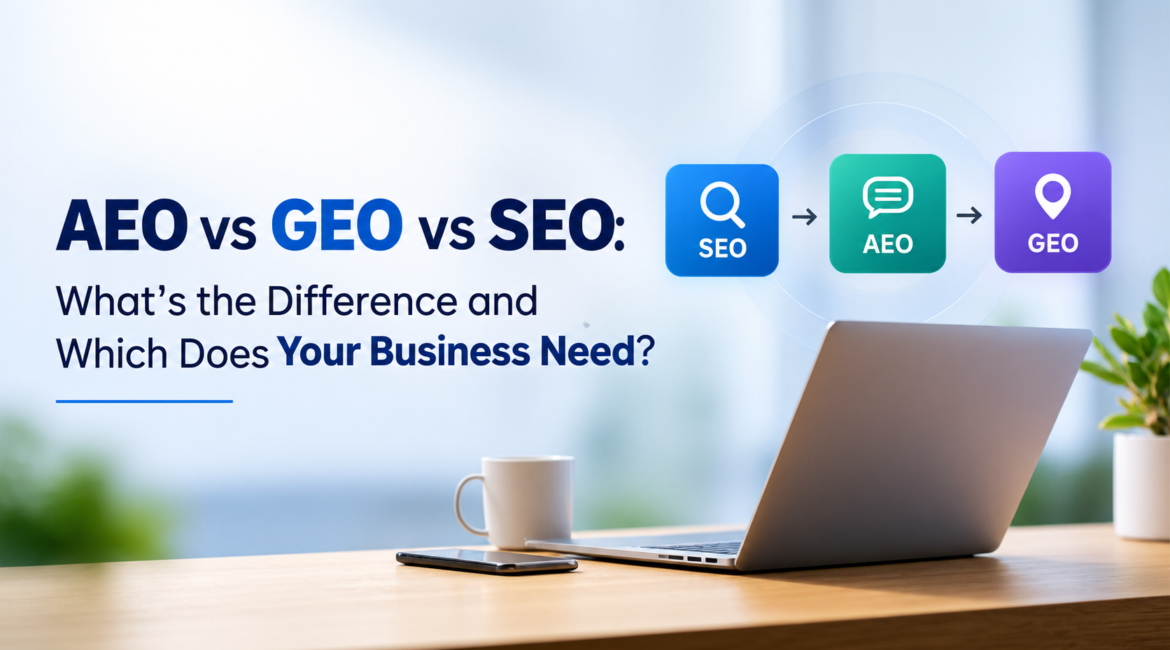
Here’s the honest answer to AEO vs GEO vs SEO: they aren’t three competing strategies. They’re three layers of the same goal, which is getting your business found when customers search, whether they use Google, a voice assistant or an AI tool like ChatGPT.
At Simba Squad, we plan all three together for clients across India, Australia, Canada, the UK and the US. This guide breaks down what each one means, where they overlap and where your budget should go first.
What’s the Difference Between AEO, GEO and SEO?
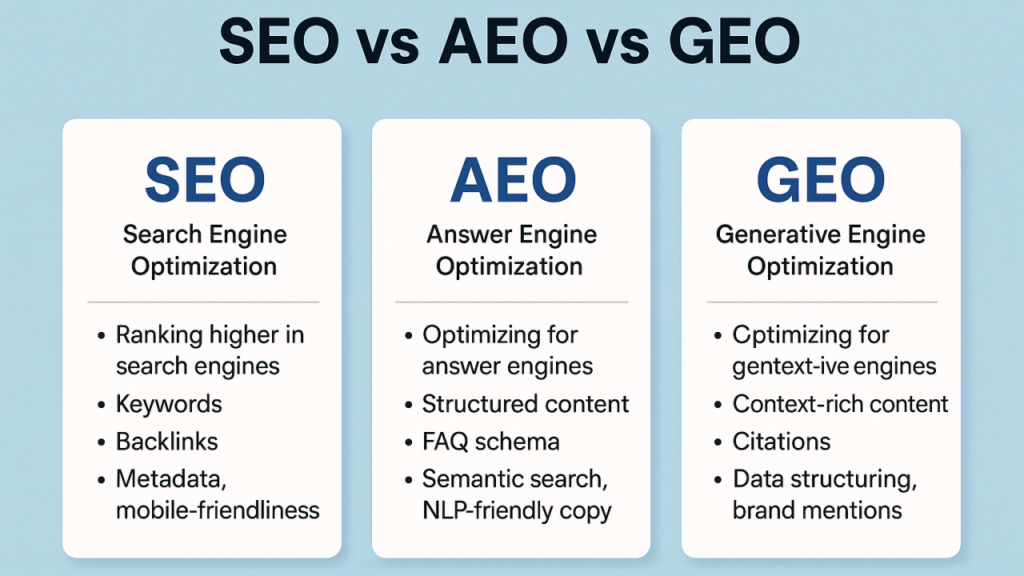
SEO (search engine optimization) helps your pages rank in search results so people click through to your site. AEO (answer engine optimization) structures your content so search engines and voice assistants can pull a direct answer from it. GEO (generative engine optimization) helps your brand get cited or mentioned inside AI-generated answers from tools like ChatGPT, Gemini, Perplexity and Google AI Overviews.
| SEO | AEO | GEO | |
| Main goal | Rank pages and earn clicks | Become the direct answer | Get cited or named in AI answers |
| Where it shows | Google and Bing results | Featured snippets, People Also Ask, voice assistants | ChatGPT, Gemini, Perplexity, Claude, AI Overviews, AI Mode |
| Key tactics | Technical health, keywords, content, links | Question headings, short direct answers, FAQs | Sourced facts, clear entity info, off-site mentions |
| How you measure it | Rankings, traffic, leads | Snippet and PAA ownership | Citations across AI prompts, AI referral traffic |
What Is SEO?
SEO is the work of getting your website to rank in search engines for the terms your customers use. It covers technical health (speed, crawlability, mobile usability), content that matches search intent, links from other websites and, for local businesses, a strong Google Business Profile.
SEO is still the foundation for everything else. Google’sguidance on AI features says the same SEO best practices apply to AI Overviews and AI Mode, with no special extra requirements. If search engines can’t find and understand your site, AEO and GEO have nothing to work with.
What Is AEO (Answer Engine Optimization)?
AEO is about structuring content so a search engine can lift a clean, direct answer from it. The term took off with featured snippets and voice assistants like Siri, Alexa and Google Assistant, which read out one answer instead of a list of links.
In practice, AEO looks like this:
• Headings written as the real questions people ask
• A clear 40 to 60 word answer straight under each question
• FAQ sections that target long-tail and voice queries
• Lists and tables for steps, comparisons and specifications
What Is GEO (Generative Engine Optimization)?
GEO focuses on AI tools that write a fresh answer by combining several sources. The term comes from aresearch paper on generative engine optimization by researchers from Princeton and other universities, presented at KDD 2024. It found that adding statistics, quotations and sources improved content visibility in AI answers by up to 40%.
GEO matters because AI tools don’t simply copy the top Google results.Moz research across nearly 40,000 queries found that 88% of links cited in Google’s AI Mode didn’t appear in the organic top 10 for the same keyword. GEO work focuses on sourced facts, a clear brand identity and mentions on other trusted websites. Our guide on how to get your brand cited in AI-generated answers covers the full playbook.
Where AEO, GEO and SEO Overlap
The overlap is bigger than most agencies admit. A well-built page that loads fast, answers a clear question in its opening lines, backs claims with sources and covers the topic thoroughly serves all three at once.
That’s why splitting them into separate projects rarely makes sense. The differences show up mostly in where you focus extra effort and how you measure results, not in a completely different way of creating content.
How You Measure Success Is Different
• SEO: keyword rankings, organic traffic and leads or sales from search, tracked in Google Search Console and GA4.
• AEO: how many featured snippets and People Also Ask boxes you own for your target questions.
• GEO: how often your brand is named or linked when you test real buyer prompts in AI tools, plus referral traffic from sites like chatgpt.com and perplexity.ai.
Which One Does Your Business Need?
Most businesses need all three, but not in equal measure. Here’s how we usually weigh them:
Local Service Businesses
Start with SEO and AEO. A complete Google Business Profile, strong location pages and FAQ content answering local questions drive most of your leads. GEO comes through genuine reviews and mentions in local directories and publications.
B2B Companies, SaaS and Agencies
Put GEO near the top of the list. B2B buyers often research and shortlist vendors through AI tools before they ever contact sales. Thought leadership, original data and a clear brand identity across LinkedIn and industry sites carry a lot of weight here.
Ecommerce Stores
SEO and product structured data come first, with AEO for comparison and “how to choose” queries. For GEO, reviews, YouTube content and mentions in buying guides help your products appear in “best X for Y” answers.
New Websites
Build the SEO foundation before anything else. AI tools and answer engines can only cite pages they can find and trust, so technical health and core content come first.
Do You Need a Separate GEO or AEO Strategy?
No. You need one search strategy that accounts for all three. Be wary of standalone “GEO packages” that skip technical SEO or content quality. They tend to chase shortcuts, like llms.txt files or schema alone, that haven’t been shown to move AI visibility on their own.
How Simba Squad Approaches AEO, GEO and SEO
At Simba Squad, we don’t sell these as separate services. Our team in Ahmedabad builds one plan covering technical SEO, answer-ready content and off-site brand building, then tracks results across Google and AI tools alike.
If you’re unsure where your business stands, our SEO services start with an audit that shows which layer needs attention first.
Frequently Asked Questions
Is GEO replacing SEO?
No. GEO builds on SEO rather than replacing it. AI tools like Google AI Overviews and AI Mode pull from search indexes, so a site with weak SEO is less likely to be cited in AI answers.
Is AEO the same as GEO?
They overlap but aren’t the same. AEO targets single direct answers like featured snippets and voice results. GEO targets AI tools that combine several sources into a new answer and cite the ones they used.
Do I need AEO if I already do SEO?
If your SEO already includes question-based headings, direct answers and FAQ content, you’re doing much of AEO already. If not, adding these is one of the quickest wins available.
How long does GEO take to show results?
It varies. Page-level improvements can show up once AI tools recrawl your content, while the brand mentions that drive consistent citations usually take a few months of steady work.
How can I tell if my business appears in AI answers?
Test 15 to 20 real buyer questions in ChatGPT, Gemini, Perplexity and Google AI Mode each month and record whether your brand is named. Check GA4 for referral traffic from AI platforms too.
Where should a small business start?
Start with SEO basics: a fast, crawlable site, a complete Google Business Profile and pages that clearly answer your customers’ main questions. That one foundation supports SEO, AEO and GEO together.
Not Sure Which One Your Business Needs?
You don’t need to master three acronyms. You need a search strategy that gets your business found wherever your customers look, whether that’s Google, a voice assistant or ChatGPT.
Book a free search visibility consultation with Simba Squad. We’ll check how you show up across Google and AI tools and tell you exactly where to focus first.