Search doesn’t work the way it did even eighteen months ago. Type a question into Google today and there’s a good chance you get a complete answer right at the top of the page, generated by AI, before a single blue link even appears. Ask ChatGPT or Perplexity the same question, and your website might be the source it quietly pulls from, summarised in a paragraph the searcher never clicks through to read.
This shift isn’t a minor update. According to SparkToro and Datos research published in 2024, over 58% of Google searches in the US and EU now end without a single click to any external website. Separately, data from BrightEdge’s 2024 AI Search report estimates AI-generated overviews now appear on close to half of all Google searches, with that share rising sharply for question-based queries. For business owners who spent years chasing the number-one Google ranking, this is a wake-up call: ranking well is no longer the whole game. Being cited, quoted, and recommended by AI systems now matters just as much.
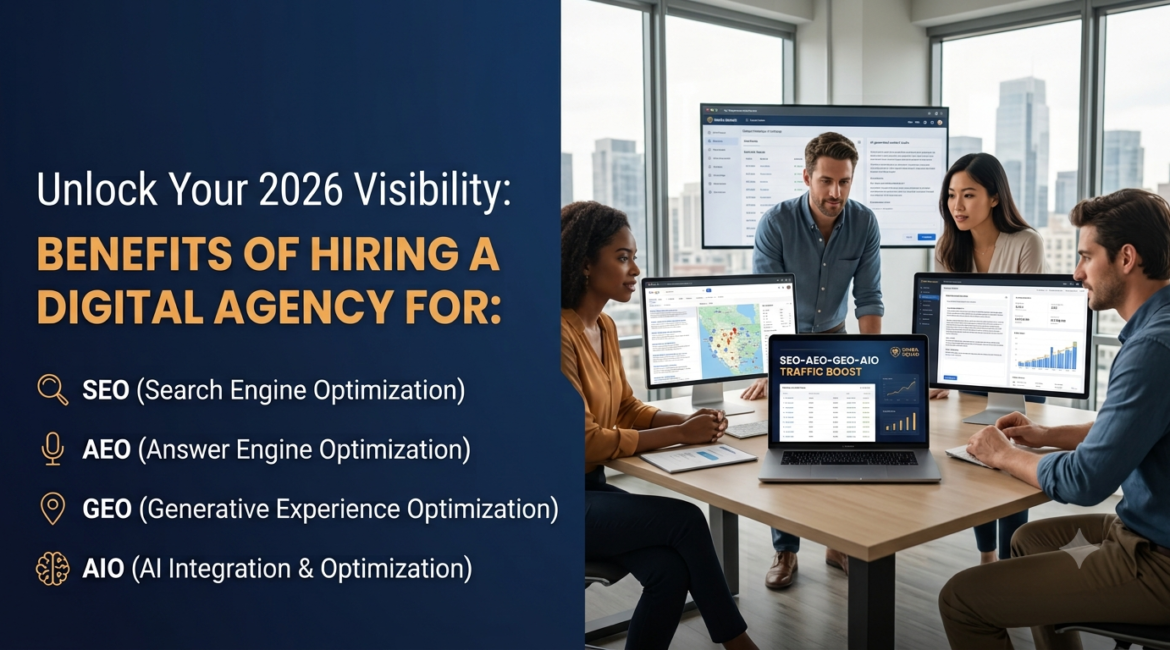
That’s why four disciplines are now sitting side by side in every serious digital marketing conversation: SEO (Search Engine Optimization), AEO (Answer Engine Optimization), GEO (Generative Engine Optimization), and AIO (AI Optimization). Each one targets a different way people discover your business today. Trying to manage all four in-house, on top of running your actual business, is where most companies fall behind and it’s exactly why hiring a specialised digital agency has become one of the smartest investments a business can make in 2026.
What Do SEO, AEO, GEO, and AIO Actually Mean?
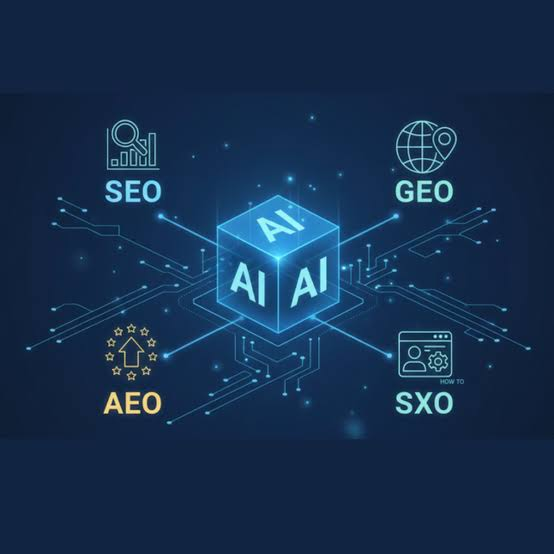
Before looking at the benefits of outsourcing this work, it helps to understand what each term covers, since they’re related but not identical.
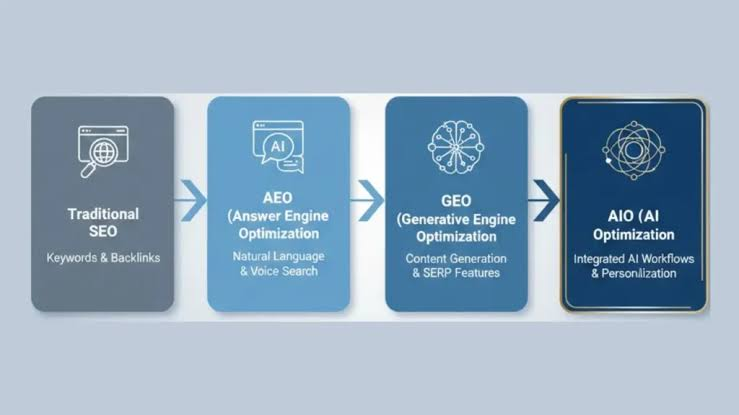
• SEO (Search Engine Optimization): The foundation. This is the classic work of getting your website to rank on Google and Bing through keyword targeting, technical performance, backlinks, and quality content.
• AEO (Answer Engine Optimization): Structuring your content so it can be pulled out and shown as a direct answer in featured snippets, voice assistant replies, and the short answer boxes that now sit above traditional results.
• GEO (Generative Engine Optimization): Making your content the kind of material that generative AI tools such as ChatGPT, Gemini, and Perplexity want to cite when they generate a response. First formalised in the 2023 paper ‘GEO: Generative Engine Optimization’ by Aggarwal et al. from Princeton University and Georgia Tech, this discipline rewards content that includes clear statistics, credible sourcing, and well-organised facts.
• AIO (AI Optimization): The umbrella layer making sure search engines and AI models alike can understand the context, entities, and meaning behind your content not just the keywords on the page.
None of these four replace the others. They stack on top of one another. A page that’s technically sound for SEO, clearly structured for AEO, rich with credible data for GEO, and semantically organised for AIO is a page built to be found everywhere someone might be looking whether that’s a Google search bar or a chat window.
Why 2026 Has Made This Harder to Ignore
A few numbers explain why this conversation has become urgent rather than optional.
• AI Overviews now appear on close to half of all Google searches, and for question-based queries, that share climbs even higher (BrightEdge, 2024).
• Over 58% of Google searches in the US and EU now end without a single click to any external website meaning the answer is already on the results page (SparkToro & Datos, 2024).
• At the same time, brands that do get cited inside an AI Overview are seeing noticeably higher click-through rates on the traffic that remains, because being named by the AI builds instant trust with the searcher.
• Research from Aggarwal et al. (Princeton/Georgia Tech, 2023) found that adding clear statistics, citing credible sources, and including direct quotations can meaningfully improve a brand’s visibility inside AI-generated answers.
Put simply: the traffic pool is shrinking, but the value of being the source an AI trusts enough to mention is rising. Businesses that keep doing SEO the old way chasing keywords without adapting content structure for AI are watching their organic visibility quietly erode, often without understanding why.
Why Managing SEO, AEO, GEO, and AIO In-House Is So Difficult
Most small and mid-sized businesses already stretch their marketing resources thin. Adding four interlocking disciplines on top of day-to-day operations creates real problems:
1. The tools and data are expensive and scattered. Monitoring how often your brand is cited inside ChatGPT or Google AI Overviews requires different tracking tools than traditional keyword rank trackers. Most business owners don’t have access to or time to learn either.
2. The rules keep changing. Google updates its AI Overview behaviour regularly, and generative engines like Perplexity or Gemini adjust how they select sources just as often. Staying current requires someone whose full-time job is watching these shifts.
3. Content now has to serve two audiences at once. Writing for a human reader and structuring that same content so an AI model can extract, understand, and cite it accurately are related but different skills. Getting both right consistently takes practice.
4. Technical foundations matter more than ever. Structured data, schema markup, clean page code, and fast accessible websites are now read by AI models just as heavily as by search engines. A single technical mistake can quietly block an entire site from being considered for AI citation.
5. There’s no single dashboard for success. Rankings, impressions, AI citation frequency, referral traffic from AI platforms, and conversions all need to be measured together to understand whether a strategy is actually working.
Trying to handle all of this alone while also running a business is where most in-house efforts either stall or burn out.
The Real Benefits of Hiring a Digital Agency in 2026
1. One Strategy, Not Four Disconnected Efforts
A good agency doesn’t treat SEO, AEO, GEO, and AIO as separate projects. They’re built into a single content and technical strategy, so every blog post, service page, and product listing is written once and optimised to perform across traditional search, voice assistants, and AI chat tools simultaneously.
2. Access to Tools You’d Never Buy Yourself
Agencies invest in enterprise-grade platforms for keyword research, AI citation tracking, technical audits, and competitor benchmarking tools that would cost a single business thousands of rupees a month to license and even longer to learn properly.
3. Content That’s Actually Built for AI Comprehension
This is where the shift really shows. Agencies experienced in GEO and AIO know how to structure content with clear headings, direct answers near the top, well-labelled FAQs, and original data points the exact ingredients generative engines look for when deciding what to cite. This isn’t about writing for robots instead of people; it’s about writing clearly enough that both can understand it.
4. Technical SEO and Structured Data, Done Right
Schema markup for FAQs, services, articles, and local business listings helps both Google and AI models understand exactly what your page is about. An experienced agency audits this properly, fixes crawl issues, improves page speed, and makes sure your site’s technical health isn’t quietly working against you.
5. Stronger Local Visibility
For a business based in Ahmedabad, or serving clients across Gujarat and India, GEO also has a local dimension. AI-driven local discovery now pulls heavily from Google Business Profiles, local citations, and location-specific content. An agency that understands local search can make sure your business shows up when someone nearby or an AI assistant answering on their behalf asks for services like yours.
6. Time and Cost Efficiency
Hiring, training, and retaining an in-house team covering SEO, content writing, technical development, and AI optimisation is expensive. An agency gives you access to a full team — writers, developers, analysts, and strategists for a fraction of the cost of building that team internally.
7. Continuous Monitoring, Not a One-Time Fix
Search behaviour changes month to month. Agencies track how often your brand appears in AI Overviews, how your rankings move, and how much traffic and how many leads are coming from each channel then adjust the strategy accordingly instead of setting it once and forgetting it.
8. Measurable Business Outcomes
At the end of the day, visibility only matters if it turns into enquiries, calls, and customers. A results-driven agency ties SEO, AEO, GEO, and AIO work back to real business metrics traffic quality, conversion rate, and revenue rather than vanity rankings alone.
How Simba Squad Approaches SEO, AEO, GEO & AIO
Simba Squad works with businesses across India, Australia, and beyond, combining SEO and content writing with website development, UI/UX design, and paid advertising under one roof. That combination matters more in 2026 than it used to, because AI systems and search engines both reward websites that are fast, well-structured, and genuinely helpful to read, not just keyword-optimised.
Our approach for 2026 includes:
• Auditing your current search and AI visibility across Google, ChatGPT, and Perplexity to see where you already show up and where you’re invisible.
• Rebuilding or refining site structure and schema markup so both search engines and AI models can accurately understand your business.
• Producing content that answers real customer questions clearly and early, supported by data and credible sourcing, so it earns citations rather than getting skipped.
• Strengthening your Google Business Profile and local signals for Ahmedabad-based and pan-India visibility.
• Tracking rankings, AI citations, and conversions together, so you always know what’s actually driving business growth.
Questions to Ask Before Hiring Any Agency
Not every agency claiming to ‘do AEO and GEO’ is actually equipped for it. Before signing on, ask:
• Can you show examples of content that’s been cited in AI Overviews or by tools like ChatGPT or Perplexity?
• How do you measure AI citation frequency — not just keyword rankings?
• Do you handle both the technical side (schema, site speed, structured data) and the content side in-house?
• What does your reporting look like, and how often will I see it?
• How do you keep up with changes to Google’s AI Overviews and generative engine behaviour?
A team that can answer these clearly, with real examples, is far more likely to deliver results than one still selling last decade’s SEO playbook.
Frequently Asked Questions
What’s the difference between SEO and GEO?
SEO focuses on ranking your website in traditional search results so people click through to your site. GEO focuses on getting your content cited or summarised inside AI-generated answers from tools like ChatGPT, Gemini, and Google’s AI Overviews where the user may never click through at all.
Is traditional SEO still worth investing in during 2026?
Yes. SEO remains the foundation everything else is built on. AI systems and answer engines still rely heavily on the same signals site structure, authority, and content quality that traditional SEO has always prioritised. AEO, GEO, and AIO build on top of strong SEO; they don’t replace it.
How long does it take to see results from AEO and GEO work?
Most businesses start seeing measurable movement in AI citations and search visibility within three to six months, depending on the current state of the website and how competitive the industry is. Consistent content publishing and technical improvements speed this up.
Can a small business in Ahmedabad really compete for AI search visibility?
Yes. AI-driven local discovery actually helps smaller, well-optimised local businesses, because generative engines and local search results favour accurate, specific, and well-structured information over generic, high-volume content. A focused local strategy often outperforms a large but unfocused one.
What does AIO mean for my website specifically?
AIO means making sure your website’s content, headings, and structure clearly convey what your business does, who it serves, and why it’s credible in a way that’s easy for AI models to interpret and reuse accurately. It’s less about stuffing keywords and more about clarity and structure.
Do I need a separate strategy for SEO, AEO, GEO, and AIO?
No and trying to run four separate strategies usually causes more confusion than results. The most effective approach treats them as layers of one unified content and technical strategy, which is exactly how an experienced agency structures the work.
Ready to Get Found By People and AI
Search isn’t disappearing, but it is splitting into more channels than ever: Google’s blue links, AI Overviews, voice assistants, and chatbot answers. Businesses that adapt their SEO, AEO, GEO, and AIO strategy together rather than treating them as separate boxes to check are the ones that will still be visible three years from now.
If you’d rather focus on running your business while a dedicated team handles your visibility across Google and AI search, Simba Squad is here to help.
Get in touch at simbasquad.com/contact
Let’s build a search strategy that works everywhere your customers are looking.