
If you run a business website, you’ve probably felt the ground shift under your rankings at least once in the past two months. Google closed out its May 2026 Core Update on June 2, and barely three weeks later, on June 24, 2026, it launched a fresh Spam Update the second spam-focused rollout of the year. For business owners who depend on organic search for leads, calls, and sales, this back-to-back pace is no longer the exception. It’s becoming the norm.
At Simbasquad, we track every major Google update because our clients’ visibility depends on it. In this article, we’ll break down what the June 2026 Spam Update actually targets, how it connects to the May Core Update that came before it, what the real benefits and drawbacks of this update mean for businesses, and why partnering with an experienced SEO team is no longer optional if you want to stay visible.
A Quick Recap: The May 2026 Core Update
Before we get to the latest change, it’s worth understanding the update that set the stage for it. Google’s May 2026 Core Update rolled out between May 21 and June 2, 2026 roughly twelve days of near-constant ranking movement across nearly every industry, from local services and healthcare to eCommerce and professional services.
Tracking tools reported that the vast majority of top-100 rankings shifted position during this window, and several SEO analysts described it as heavier and more disruptive than the March 2026 Core Update earlier in the year. What made this update especially notable was its timing — it landed just days after Google I/O 2026, where the company unveiled major upgrades to AI Mode and its Gemini-powered search experience. Many practitioners noted that click-through rates on queries showing AI Overviews dropped sharply, even when a page’s ranking position stayed the same, because AI-generated summaries were increasingly answering the query before a user ever reached the search results.
The takeaway from May was simple: strong rankings alone no longer guarantee strong traffic. Visibility inside AI-generated answers has become just as important as the traditional blue link.
What’s New: The June 2026 Spam Update
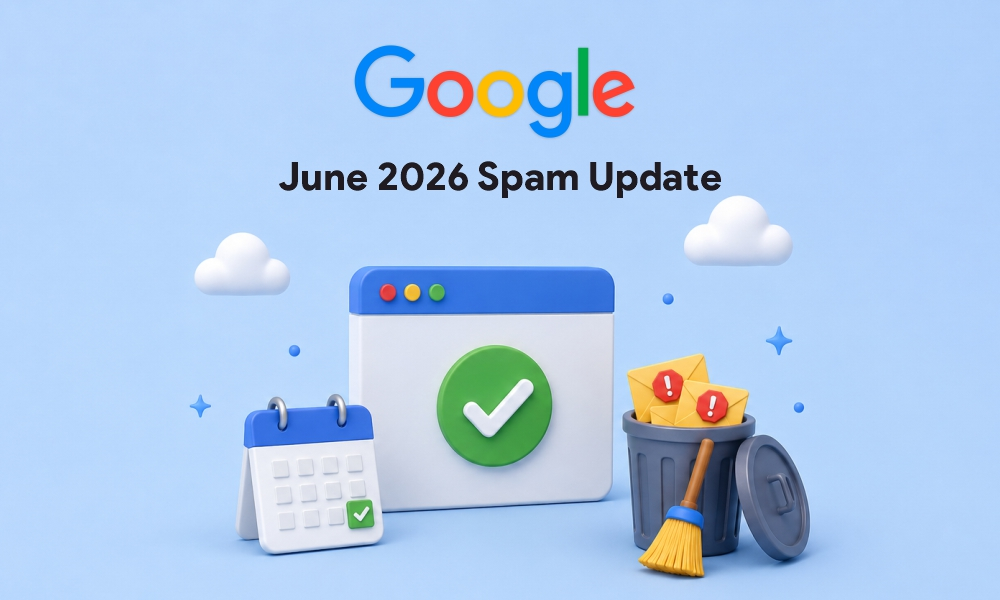
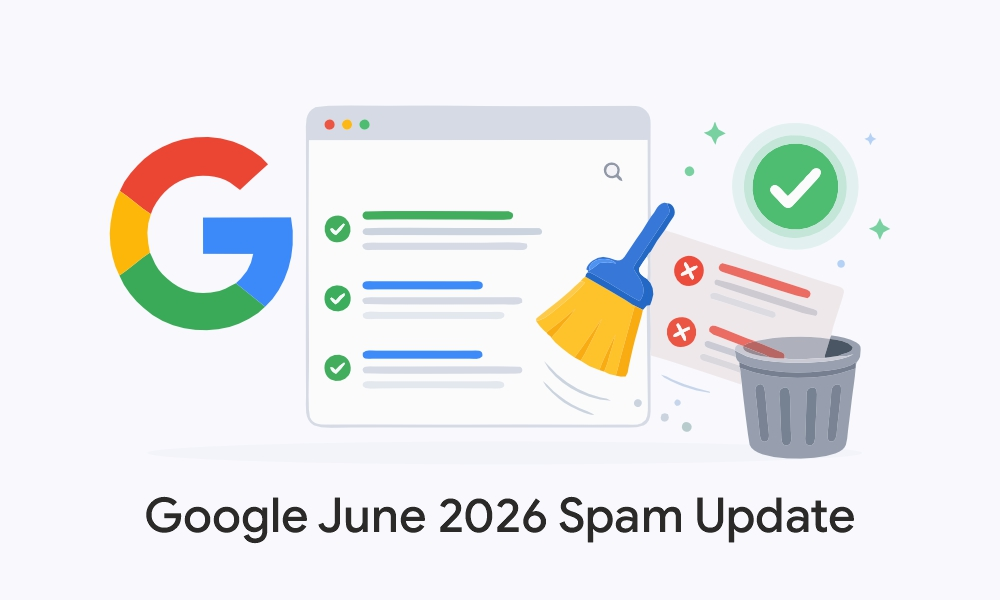
Just as businesses were settling into their post-Core-Update baselines, Google rolled out a separate action on June 24, 2026 a global Spam Update. Unlike a core update, which recalibrates how Google’s systems judge overall content quality and relevance, a spam update is targeted. It goes after specific practices that violate Google’s spam policies rather than reassessing quality signals across the board.
Based on Google’s stated spam policies, this update focuses on:
- Scaled content abuse — websites mass-publishing large volumes of thin or AI-generated pages with little to no human oversight or original insight, created primarily to rank rather than genuinely help readers
- Doorway pages — pages built to funnel users toward another page or site rather than serve a real purpose
- Cloaking and deceptive practices — showing different content to users than what’s shown to Google’s crawlers
- Expired domain abuse — buying expired domains with existing authority and repurposing them with unrelated, low-value content solely to manipulate rankings
- Manipulated or purchased citations — a newer concern Google flagged specifically in relation to AI-generated search answers, warning site owners against trying to buy or fake the signals that influence AI Overviews and AI Mode responses
This is an important distinction for business owners: a core update can lower your visibility even if you haven’t done anything wrong, simply because Google’s quality benchmark shifted. A spam update, on the other hand, is a much stronger signal. If your site loses visibility after a spam update, there’s a real chance something on your site or a shortcut a previous agency took is triggering a genuine policy violation, and generic “wait it out” advice won’t fix that.
Why These Back-to-Back Updates Matter for Your Business
Two major algorithm actions inside of five weeks is a pace most businesses haven’t planned for. Here’s what that volatility can mean in practical terms:
- Sudden drops in website traffic even without any changes to your own site
- Fewer form fills, calls, and walk-ins from organic search
- AI Overviews absorbing clicks that used to land on your website, even when you still rank well
- Increased pressure to spend more on paid ads just to maintain the lead volume you used to get organically
- Confusion about the cause — is it the Core Update, the Spam Update, a technical issue, or a competitor simply doing better content?
On the flip side, businesses with a genuinely strong, well-optimized, policy-compliant website often come out ahead. Google has repeatedly said its updates are designed to reward sites that demonstrate real expertise, originality, and a good user experience and every update cycle tends to widen the gap between businesses that invest in quality SEO and those that don’t.
Benefits of Google’s Latest Updates
It’s easy to see algorithm updates as purely disruptive, but there’s a genuine upside for businesses that take SEO seriously:
1. A cleaner, fairer playing field. By targeting scaled content abuse, doorway pages, and expired domain manipulation, Google is pushing low-effort competitors out of the results which creates real opportunity for businesses producing honest, high-quality content.
2. Higher-quality traffic. When Google gets better at surfacing genuinely useful pages, the visitors who do click through tend to be more relevant and more likely to convert.
3. Long-term stability for compliant sites. Businesses that have never relied on manipulative tactics generally see far less volatility across updates, because there’s nothing in their strategy for Google to “correct.”
4. A clear signal to invest in real expertise. These updates make it easier to justify investing in original research, case studies, expert-written content, and genuine customer value the kind of content that also builds trust with real customers, not just algorithms.
Disadvantages and Real Challenges
That said, it would be dishonest to pretend these updates come without pain points:
1. Unpredictability. Even well-run websites can see temporary ranking swings during a rollout, simply due to the scale of recalibration happening across Google’s index.
2. Shrinking organic click-through rates. As AI Overviews and AI Mode expand, even a first-position ranking doesn’t guarantee the traffic it once did some queries now answer the user directly on the results page.
3. No formal recovery process. Unlike a manual penalty, there’s no “reconsideration request” for a core or spam update. Recovery depends entirely on demonstrable, sustained content and technical improvements; there’s no shortcut.
4. Higher resource demands. Competing after these updates increasingly requires structured data, stronger E-E-A-T (experience, expertise, authority, trust) signals, and content built around real depth which takes more time, skill, and investment than older, simpler SEO tactics.
5. Diagnosis is harder than it looks. Distinguishing between a core update effect, a spam update effect, a technical crawl issue, and simple seasonal demand change requires real data analysis not guesswork.
What Businesses Should Do Right Now
If your traffic or rankings moved after either of these updates, resist the urge to panic-edit your site. Google itself recommends waiting until data stabilizes generally about a week after a rollout completes before drawing conclusions. From there, a proper response includes:
- Pulling multi-week Search Console data instead of comparing single days
- Auditing your content for thin, outdated, or AI-generated pages lacking real human insight
- Reviewing technical health: site speed, mobile experience, crawlability, and structured data
- Checking your backlink profile and any past SEO practices that may now fall under spam policy scrutiny
- Building content depth around topics where you have genuine, first-hand expertise
- Optimizing for AI-driven search experiences, not just traditional rankings
Why SEO Is Good for Business — Now More Than Ever
With algorithm updates arriving more frequently and AI reshaping how people search, SEO has moved from being a “nice to have” marketing line item to a core business function. Done right, SEO:
- Builds a sustainable stream of leads that doesn’t disappear the moment you pause ad spend
- Builds long-term brand trust and authority in your industry
- Improves your website’s usability, speed, and overall customer experience
- Keeps your business visible inside AI-generated answers, not just traditional search results
- Costs less over time than constantly rising paid advertising rates
- Compounds — the work you do today keeps paying off months and years later
The businesses that treat SEO as a continuous, evolving discipline not a one-time project are the ones consistently coming out ahead after every update Google releases.
Here’s the full article as plain text you can copy-paste directly, plus I’ll also generate a Word doc version.
A Quick Recap: The May 2026 Core Update
Before we get to the latest change, it’s worth understanding the update that set the stage for it. Google’s May 2026 Core Update rolled out between May 21 and June 2, 2026 roughly twelve days of near-constant ranking movement across nearly every industry, from local services and healthcare to eCommerce and professional services.
Tracking tools reported that the vast majority of top-100 rankings shifted position, and several SEO analysts called it heavier than the March 2026 Core Update earlier in the year. Timing made it notable too — it landed just days after Google I/O 2026, where Google unveiled major upgrades to AI Mode. Many practitioners noted click-through rates on AI Overview queries dropping sharply even when a page’s ranking position stayed the same, because AI-generated summaries increasingly answered the query before users reached the results.
The takeaway from May was simple: strong rankings alone no longer guarantee strong traffic. Visibility inside AI-generated answers matters just as much as the traditional blue link now.
What’s New: The June 2026 Spam Update
Just as businesses were settling into their post-Core-Update baselines, Google rolled out a separate action on June 24, 2026 a global Spam Update. Unlike a core update, which recalibrates how Google’s systems judge overall quality, a spam update is targeted: it goes after specific practices that violate Google’s spam policies rather than reassessing quality signals broadly.
This update focuses on:
- Scaled content abuse — websites mass-publishing large volumes of thin or AI-generated pages with little to no human oversight or original insight, created primarily to rank rather than genuinely help readers
- Doorway pages — pages built to funnel users toward another page or site rather than serve a real purpose
- Cloaking and deceptive practices — showing different content to users than what’s shown to Google’s crawlers
- Expired domain abuse — buying expired domains with existing authority and repurposing them with unrelated, low-value content solely to manipulate rankings
- Manipulated or purchased citations — a newer concern Google flagged specifically in relation to AI-generated search answers, warning site owners against trying to buy or fake the signals that influence AI Overviews and AI Mode responses
This is an important distinction for business owners: a core update can lower your visibility even if you haven’t done anything wrong, simply because Google’s quality benchmark shifted. A spam update, on the other hand, is a much stronger signal. If your site loses visibility after a spam update, there’s a real chance something on your site — or a shortcut a previous agency took is triggering a genuine policy violation, and generic “wait it out” advice won’t fix that.
Why These Back-to-Back Updates Matter for Your Business

Two major algorithm actions inside of five weeks is a pace most businesses haven’t planned for. Here’s what that volatility can mean in practical terms:
- Sudden drops in website traffic even without any changes to your own site
- Fewer form fills, calls, and walk-ins from organic search
- AI Overviews absorbing clicks that used to land on your website, even when you still rank well
- Increased pressure to spend more on paid ads just to maintain the lead volume you used to get organically
- Confusion about the cause — is it the Core Update, the Spam Update, a technical issue, or a competitor simply doing better content?
On the flip side, businesses with a genuinely strong, well-optimized, policy-compliant website often come out ahead. Google has repeatedly said its updates are designed to reward sites that demonstrate real expertise, originality, and a good user experience — and every update cycle tends to widen the gap between businesses that invest in quality SEO and those that don’t.
Benefits of Google’s Latest Updates
It’s easy to see algorithm updates as purely disruptive, but there’s a genuine upside for businesses that take SEO seriously:
1. A cleaner, fairer playing field. By targeting scaled content abuse, doorway pages, and expired domain manipulation, Google is pushing low-effort competitors out of the results, creating real opportunity for businesses producing honest, high-quality content.
2. Higher-quality traffic. When Google gets better at surfacing genuinely useful pages, visitors who click through tend to be more relevant and more likely to convert.
3. Long-term stability for compliant sites. Businesses that have never relied on manipulative tactics generally see far less volatility across updates, since there’s nothing for Google to “correct.”
4. A clear signal to invest in real expertise. These updates make it easier to justify investing in original research, case studies, and expert-written content — the kind that also builds trust with real customers, not just algorithms.
Disadvantages and Real Challenges
That said, it would be dishonest to pretend these updates come without pain points:
1. Unpredictability. Even well-run websites can see temporary ranking swings during a rollout, simply due to the scale of recalibration happening across the index.
2. Shrinking click-through rates. As AI Overviews and AI Mode expand, even a first-position ranking doesn’t guarantee the traffic it once did, since some queries now get answered directly on the results page.
3. No formal recovery process. Unlike a manual penalty, there’s no “reconsideration request” for a core or spam update. Recovery depends entirely on demonstrable, sustained improvements.
4. Higher resource demands. Competing now increasingly requires structured data and stronger E-E-A-T (experience, expertise, authority, trust) signals — more time and investment than older, simpler tactics.
5. Diagnosis is harder than it looks. Distinguishing a core update effect, a spam update effect, a technical issue, and seasonal demand change requires real data analysis, not guesswork.
What Businesses Should Do Right Now
If your traffic or rankings moved after either of these updates, resist the urge to panic-edit your site. Google itself recommends waiting until data stabilizes — generally about a week after a rollout completes — before drawing conclusions. From there, a proper response includes:
- Pulling multi-week Search Console data instead of comparing single days
- Auditing your content for thin, outdated, or AI-generated pages lacking real human insight
- Reviewing technical health: site speed, mobile experience, crawlability, and structured data
- Checking your backlink profile and any past SEO practices that may now fall under spam policy scrutiny
- Building content depth around topics where you have genuine, first-hand expertise
- Optimizing for AI-driven search experiences, not just traditional rankings
Why SEO Is Good for Business — Now More Than Ever
With algorithm updates arriving more frequently and AI reshaping how people search, SEO has moved from being a “nice to have” marketing line item to a core business function. Done right, SEO:
- Builds a sustainable stream of leads that doesn’t disappear the moment you pause ad spend
- Builds long-term brand trust and authority in your industry
- Improves your website’s usability, speed, and overall customer experience
- Keeps your business visible inside AI-generated answers, not just traditional search results
- Costs less over time than constantly rising paid advertising rates
- Compounds — the work you do today keeps paying off months and years later
The businesses that treat SEO as a continuous, evolving discipline — not a one-time project — are the ones consistently coming out ahead after every update Google releases.
Frequently Asked Questions
1. What is the difference between a Google Core Update and a Spam Update?
A core update recalibrates how Google judges quality and relevance across the entire index; it doesn’t target any specific site. A spam update is narrower: it specifically targets sites violating Google’s spam policies, like scaled AI content, doorway pages, or expired domain abuse. Losing rankings after a spam update is a stronger signal that something on your site needs fixing.
2. My website’s traffic dropped after May or June 2026 — what should I do first?
Don’t make rushed changes. Pull two to three weeks of Search Console data from before and after the update rather than comparing single days, since rankings fluctuate during rollouts. A gradual decline usually points to a content issue; a sharp step-change on a known update date points to the algorithm.
3. How long does it take to recover from a core or spam update?
There’s no fixed timeline and no formal reconsideration request like manual penalties have. Recovery depends on genuine, sustained improvements to content and technical health. Some sites see partial recovery between update cycles; others need to wait for the next major update.
4. Are AI Overviews reducing my traffic even if my rankings haven’t changed?
Yes, this is increasingly common. If your position stayed the same but click-through rate dropped, an AI Overview may be answering the query before users reach your listing. This needs a different strategy one focused on structured data and content AI systems want to cite.
5. Do I really need an SEO agency, or can I manage this on my own?
You can manage basic SEO in-house, but keeping pace with Google’s current update frequency takes ongoing monitoring and technical expertise most business owners don’t have time for. An experienced partner can tell the difference between update-related fluctuations and real site issues.
How Simbasquad Can Help
Keeping up with Google’s pace of change while running your business is a full-time job in itself which is why so many businesses in Ahmedabad and beyond choose to work with a dedicated SEO partner. At Simbasquad, we monitor every core and spam update as it happens, audit your website against Google’s latest quality signals, and build content and technical strategies designed to hold up through whatever Google rolls out next including the growing world of AI-powered search.
Whether your rankings dropped after the May Core Update, you’re worried about the June Spam Update, or you simply want a website that performs consistently no matter what Google changes next, our team is ready to help.
Get in touch with Simbasquad today:
📞 +91 9664772676 📍 Ahmedabad, Gujarat
Let’s build an SEO strategy that grows with every update not one that gets caught off guard by it.